RFC 2544 Ethernet Switch Benchmark Testing
RFC 2544 is the industry-standard methodology for benchmarking the performance of network devices such as Ethernet switches. Published by the IETF, it defines a repeatable set of tests — throughput, latency, frame loss, and back-to-back frames — that let engineers compare devices on equal, vendor-neutral terms.
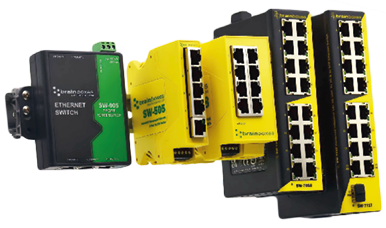
Brainboxes publishes full RFC 2544 test reports for the SW range of industrial Ethernet switches. Each report documents exactly how a switch performs across the full range of Ethernet frame sizes, with per-port data and charts.
In a hurry? Jump straight to the Brainboxes SW range RFC 2544 results.
What is RFC 2544?
RFC 2544, "Benchmarking Methodology for Network Interconnect Devices," is a specification published by the Internet Engineering Task Force (IETF) in March 1999. It builds on the terminology defined in RFC 1242 and supersedes the earlier RFC 1944.
The standard exists to solve a simple problem: vendors measure performance in different ways, which makes published figures hard to compare. RFC 2544 defines exactly how each test is set up, run, and reported, so that results from any compliant test are directly comparable — regardless of who performed them or which device was tested.
For industrial networks running protocols such as PROFINET, EtherNet/IP, and Modbus TCP, deterministic switch performance is critical. RFC 2544 results let system integrators verify that a switch forwards traffic at line rate with predictable latency and zero frame loss before it is deployed on the factory floor.
The four RFC 2544 benchmark tests
| Test | What it measures | Why it matters |
|---|---|---|
| Throughput | The maximum frame rate the device forwards with zero frame loss | The headline capacity figure — confirms the switch handles full line rate |
| Latency | The time a frame takes to transit the device | Critical for time-sensitive industrial and real-time protocols |
| Frame Loss Rate | The percentage of frames dropped at a given offered load | Reveals how the device behaves under network congestion |
| Back-to-Back Frames | The longest burst of frames at full rate absorbed without loss | Reflects the device's buffer capacity for bursty traffic |
Alongside latency, the test suite also reports jitter — the variation between consecutive latency measurements. Low, consistent jitter matters for synchronised and motion-control applications.
Frame sizes used in testing
A switch works hardest when it processes the highest number of frames per second, which happens at the smallest frame size. RFC 2544 therefore runs every test across a range of frame sizes rather than reporting a single average.
Brainboxes tests the IEEE default frame sizes: 64, 128, 256, 512, 1024, 1280, and 1518 bytes.
- 64 bytes — the minimum Ethernet frame. Produces the highest frame rate and stresses the switching fabric hardest.
- 1518 bytes — the maximum standard (non-jumbo) Ethernet frame.
- Jumbo frames — Gigabit models that support jumbo frames are additionally tested at sizes up to 9000 bytes (9018 bytes on the SW-084), reflecting their use in high-throughput data transfers.
How the tests are performed
Brainboxes runs RFC 2544 tests using the Xena2544 automated test suite on Xena Networks test hardware, following the standard methodology:
- Full-mesh, bidirectional topology — every port transmits to every other port simultaneously, exercising the switch fabric at full load.
- All ports at line rate — 100 Mbps for Fast Ethernet models, 1000 Mbps for Gigabit models.
- 60-second trials, averaged over 3 iterations for each frame size.
- Binary search between 95% and 100% of line rate to find the highest zero-loss throughput.
Each report lists the exact test chassis, module, and software version used, so the results are fully traceable.
Understanding the reported metrics
| Metric | Meaning |
|---|---|
| Tx/Rx Rate (L1) | Layer 1 line rate, including the preamble and inter-frame gap |
| Tx/Rx Rate (L2) | Layer 2 data rate — the frame bytes only |
| fps | Frames per second |
| Latency (µs) | Forwarding delay through the device, in microseconds |
| Jitter (µs) | Variation between consecutive latency measurements |
Related documentation
- SW Industrial Ethernet Switches — range overview — quick start guides, datasheets, and ordering
- SW Ethernet Switches Reference Manual — hardware features and specifications
- RFC 2544 specification — the full IETF standard
- Xena2544 test suite — the automated tool used for these tests
